An acoustic rating is only useful when you know what was tested and how the result is written. Before comparing two figures, check the measure used, what was tested and the conditions behind each result.
What Rw tells you
Rw is the weighted sound reduction index. It is a single-number rating of the airborne sound insulation of a building element, derived from frequency-dependent sound insulation results using a standardised rating procedure.
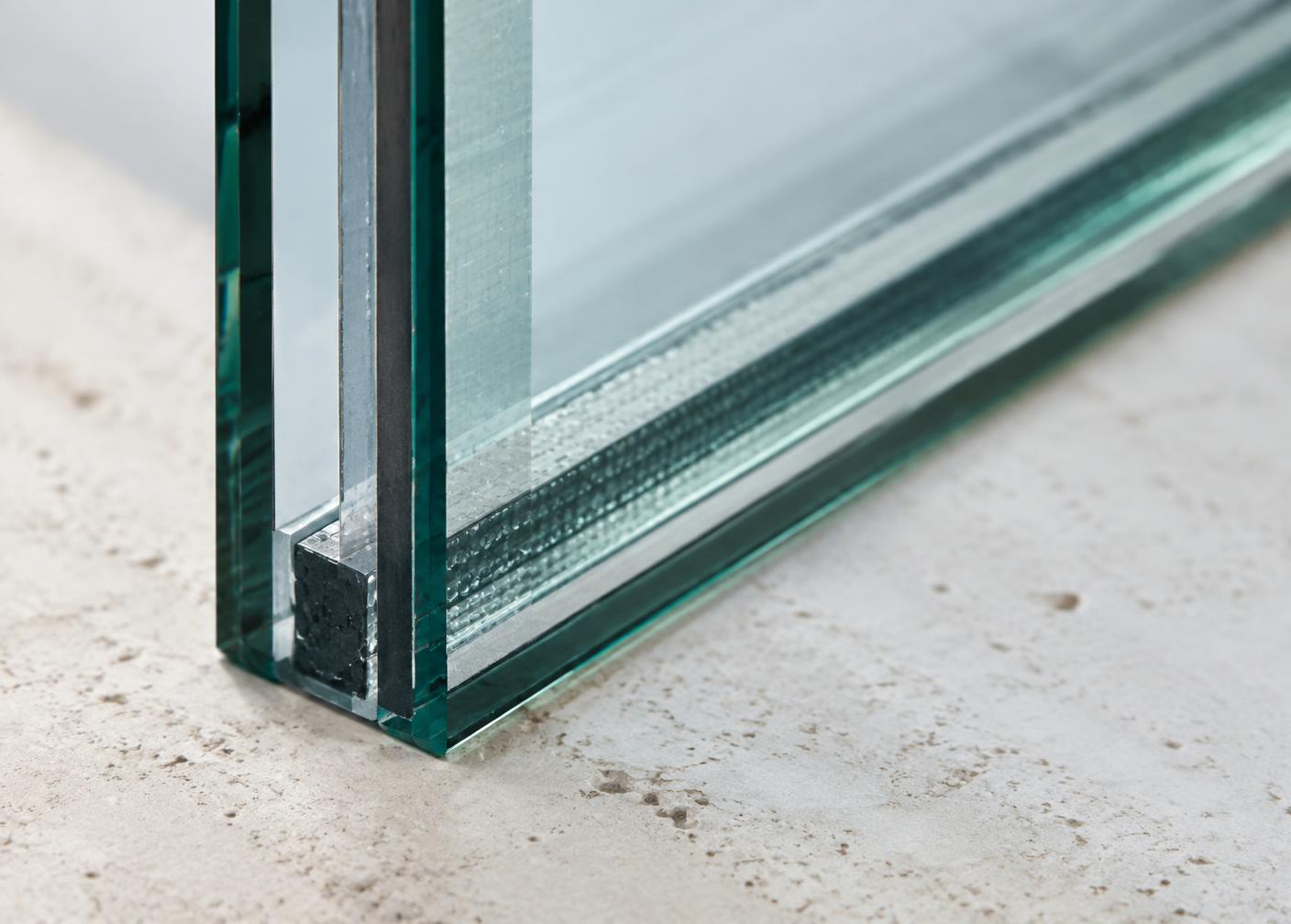
The element might be a glass specimen, a window assembly or another construction. The letters Rw alone do not tell you which item was tested. Read the report description as well as the figure. The relevant rating framework is ISO 717-1; laboratory measurement and glazing-product evidence have their own supporting standards.
Why C and Ctr sit beside Rw
C and Ctr are spectrum adaptation terms. They help express the rated performance with reference to defined source spectra. They are not extra layers of glazing and should not be treated as interchangeable labels.
A report may present the notation Rw(C;Ctr), or show the combined quantities Rw+C and Rw+Ctr separately. Retain the signs and notation used in the report. Ask the project acoustician which quantity is relevant to the design brief, especially where the noise contains prominent low-frequency components or individual events.
Do not select an adaptation term solely because the source has been described as “traffic” or “aircraft”. The source information and the project assessment need to support the choice.
A worked example (hypothetical)
For teaching purposes only, consider the invented notation Rw(C;Ctr) = 40(-1;-5) dB. The corresponding sums are Rw+C = 39 dB and Rw+Ctr = 35 dB.
These numbers describe no actual product. They illustrate how signed adaptation terms are combined with Rw. They do not mean that a room will become 35 dB quieter, or that subtracting 35 dB from an outside sound level predicts the indoor level.
Compare like with like
| Check | Question to answer |
|---|---|
| Rating quantity | Are both figures Rw, Rw+C or Rw+Ctr? |
| Assessed item | Are both figures for glass, complete windows or another element? |
| Construction | Are glass build-up, frame, seals and opening arrangement identified? |
| Report applicability | Does the evidence cover the configuration proposed for this project? |
| Design relevance | Has the project acoustician confirmed the metric and source assumptions? |
Comparing the largest number from one product sheet with a differently expressed number from another can conceal an important difference in the evidence.
What one number can’t tell you
A single-number rating does not show every detail of frequency-dependent behaviour. It also does not account, on its own, for the room, other facade elements, ventilation paths, installation or the way the building will be used.
Read glass, window and facade performance to understand those boundaries. If a quoted figure cannot be traced to suitable evidence, use the test-report review guide to prepare questions for the supplier.
Take the field guide with you
Download the Rw, C and Ctr field guide for the notation example, comparison questions and space to record the report and requirement you are reviewing. The online article remains available without a download.
Use the specification checklist or ask Hugo Carter about evidence for a proposed bespoke system.